1. Product Overview
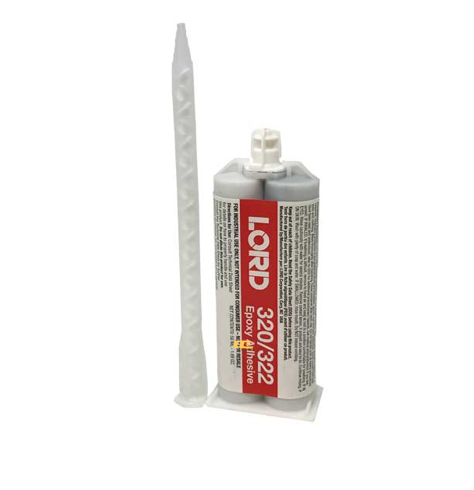
LORD® 320/322 is a two-component epoxy adhesive system designed for primerless bonding of automotive sheet molded compounds (SMC). It also bonds effectively to prepared metals, rubber, fiberglass reinforced plastics (FRP), polyester thermosets, thermoplastics, glass, and ceramics. The system can cure at room temperature or be heat-cured for accelerated processing. Offering high strength, impact resistance down to -40°C, and excellent durability, LORD 320/322 is solvent-free, nonflammable, and virtually odorless, making it environmentally recommended. It resists temperature extremes, humidity, sunlight, and salt spray, while maintaining strong adhesion even under post-bake and e-coat processes.
2. Applications
-
Bonding SMC panels in automotive applications.
-
Adhesion to prepared metals, rubber, FRP, thermosets, thermoplastics, glass, and ceramics.
-
Applications requiring crack inhibition and long-term durability under environmental exposure.
-
Structural assemblies needing resistance to solvents, post-bake temperatures, and corrosion protection systems.
3. Typical Properties
| Property |
320 Resin (Unmixed) |
322 Hardener (Unmixed) |
After Mixing |
| Appearance |
Off-white paste |
Grey paste |
Uniform, consistent blend |
| Viscosity @ 25°C (cP) |
300,000 – 1,000,000 (Brookfield HBF, Helipath 5 rpm) |
450,000 – 2,000,000 (T-Bar Spindles D/E) |
Thick, workable paste |
| Density (lb/gal / kg/m³) |
12.5 – 12.9 / 1498 – 1546 |
10.33 – 10.54 / 1238 – 1263 |
Balanced, uniform adhesive |
| Flash Point (°F/°C, Closed Cup) |
>200 / >93 |
>200 / >93 |
Safe handling during processing |
| Cure Characteristics |
– |
– |
Room temperature cure; heat cure for faster processing |
| Performance |
– |
– |
High strength, durable, impact resistant to -40°C; resists humidity, UV, salt spray, solvents, and post-bake up to 204°C |
This epoxy adhesive system delivers structural integrity equal to or greater than the bonded materials, providing long-term resistance to environmental and chemical stresses while maintaining cohesive failure.